How do AI creators make money? A reality check
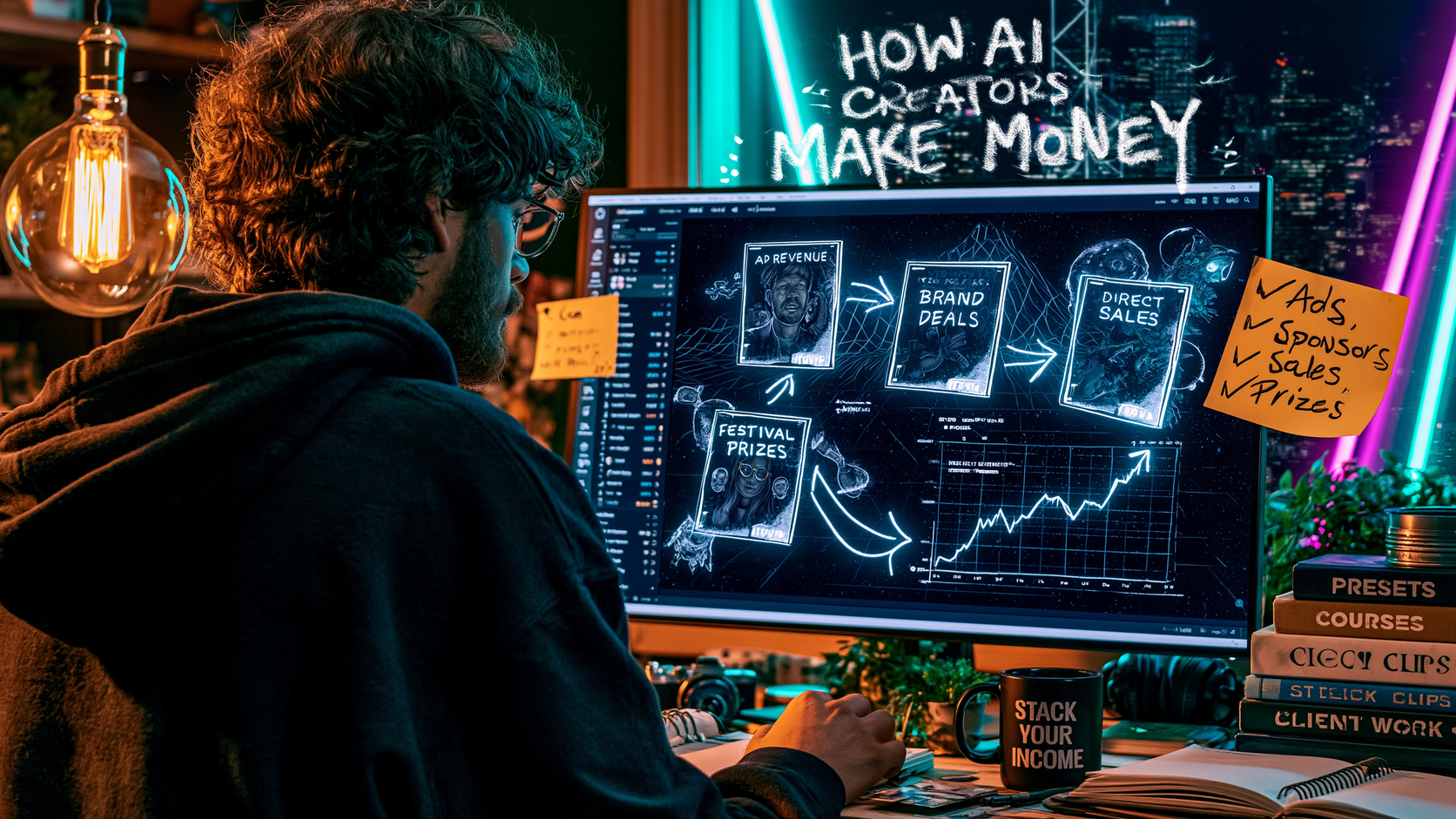
The money comes from ad revenue, brand deals, direct sales and contest prizes. Here's what each one actually pays, and what an AI filmmaker salary looks like.
Ask how AI creators make money, and someone will mention the guy making $700,000 a year. He’s real. Fortune reported in December 2025 that a 22-year-old running faceless AI channels brings in roughly that much in gross revenue, and they checked his ad-revenue records to confirm it.
By Fortune’s own account, he’s a “comparatively small fish” next to the bigger faceless channels. For everyone else, the numbers look very different.
ZipRecruiter, a jobs aggregator, puts the average AI filmmaker salary near $83,600. So the honest range for what AI creators earn runs from nothing to about $700,000, and most people are nowhere near the top of it. The money comes from the same places it does for every other online creator: ad revenue, brand deals, direct sales and contest prizes. On top of that, in 2026 YouTube clarified which videos qualify for payment at all.
Before the fine print, here’s the good news.
Why AI creation is worth pursuing
AI filmmaking is turning into a real job. ZipRecruiter’s average across all AI filmmaking listings is about $83,600, and full-time roles average about $123,600 as of June 2026. That’s advertised pay from one jobs aggregator, but the roles exist, and companies are posting them.
People are building new careers with it. Reuters profiled Michael Eng, a Hollywood visual-effects veteran who was laid off and sidelined by a production slowdown. He learned AI tools and said he started getting work immediately. Another Curious Refuge student, Petra Molnar, couldn’t get into art school in her native Budapest and used AI training to find a new career. “AI genuinely changed my life,” she told Reuters.
YouTube isn’t against AI. In the same Creator Insider video where he explained the new rules, Halprin said of AI videos: “Sometimes those videos are great, and it really enhances creativity,” as reported by TheDesk.
Sponsors pay a premium. SponsorRadar’s 2026 pricing guide puts typical display ad CPMs at $2 to $5, while sponsorship CPMs range from $15 to $80 or more, according to Kingy. For creators with an engaged audience, that’s real upside.
The catch is that none of this comes automatically. Here’s how each income stream actually works.
Ad revenue: the first paycheck everyone chases
Most creators start by chasing a cut of platform ad sales. On YouTube, that’s the YouTube Partner Program. To get in, a channel needs 1,000 subscribers plus either 4,000 valid public watch hours over the past 12 months or 10 million qualified Shorts views over the past 90 days, according to YouTube.
Hitting those numbers doesn’t mean you’re getting paid. It means YouTube will now look at you. The channel still has to pass a policy review.
TikTok pays through its Creator Rewards Program, which asks for at least 10,000 followers, 100,000 video views in the previous 30 days and videos longer than one minute. How much it pays is a bit of a mystery, because TikTok doesn’t publish a per-view rate. Creator-reported figures collected by the tracking site TT Calculator suggest roughly $0.50 to $2 per 1,000 qualified U.S. views. That’s a single-source estimate, and the site says TikTok doesn’t guarantee it.
Which AI videos does YouTube actually pay for?
On July 16, 2026, YouTube clarified its existing rules on what it calls inauthentic content, which changed how much AI content creators can monetize. It didn’t ban AI. It spelled out three kinds of video that can’t earn ad money, TechCrunch reported:
- Generic, repetitive or template-style clips with little variation
- Content built to upset or emotionally manipulate viewers
- AI personas of real people used to discuss sensitive subjects such as finance, law or health
“AI can actually allow people to make a lot of videos,” Matt Halprin, YouTube’s trust and safety chief, said in a Creator Insider video, as quoted by TechCrunch. “But that exact same new tool can allow you to make lots of videos really quickly that are very similar.”
In plain terms: the tools are fine. The content farm is not. A feed of near-identical, mass-produced clips is exactly what the policy targets.
Are brand deals worth more than ads?
If you have an engaged audience, they can be. Sponsorship rates for the broader AI and technology niche run about $30 to $60 per 1,000 views, according to SponsorRadar’s technology benchmark cited by the AI trade site Kingy. Across all niches, mid-tier channels with 100,000 to 500,000 subscribers typically get about $5,000 to $10,000 per sponsored video, according to aggregated industry data in the same report.
Treat those numbers as a rough range, not a rate card. They’re industry benchmarks, not published rates, and the same report admits data specific to AI channels is still thin.
Selling to other creators
Another way to get paid is to sell to the people doing what you’re doing. Some creators package prompt libraries, character sheets, preset and template packs, and paid courses. Some license their finished clips as stock footage or take commercial client work.
There’s real demand for the training side. Curious Refuge, an AI film school, says it has trained about 10,000 people, and that 95% of its current students already work in entertainment or advertising, Reuters reported in February 2026. So the people paying for AI film education aren’t just curious hobbyists. Most of them already work in the industry.
Can you win real money at AI film festivals?
Yes, at the top end. Runway, an AI video company, put up a prize pool of more than $135,000 at its fourth annual AI Film Festival in 2026, with a $50,000 Grand Prix and screenings in New York, Los Angeles and Tokyo, according to the festival.
That’s top-of-market money. Great to win. Not a business plan.
What does an AI filmmaker salary look like?
AI filmmaking is also turning into a regular job with a regular paycheck. Listings aggregated by ZipRecruiter showed an average AI filmmaker salary of about $83,600 a year in the United States as of a May 2026 snapshot. Most postings fell between $75,500 and $92,000, and full-time production roles ran higher.
The fine print: that figure comes from one jobs aggregator drawing on self-reported listings. It tells you what employers advertise, not what anyone actually got paid.
The reality most creators meet
Back to the $700,000 guy. Fortune’s profile ran under a headline that called the work “AI slop.” It described five faceless channels built on history, animals and other low-cost formats, costing about $6,500 a month to run.
YouTube’s 2026 policy adds another catch. A channel can build an audience and still lose its ad money if it drifts into the categories YouTube flagged.
So how do AI creators make money?
How AI creators make money comes down to stacking several income streams instead of betting on one. Platforms can change their rules with little notice, as YouTube did in July, so spreading income across ad revenue, sponsorships and direct sales means one policy update can’t wipe you out. Generic, repetitive clips are what YouTube’s policy now targets, so varied work that’s clearly your own carries less monetization risk. And a recurring character, voice or format gives an audience a reason to come back, which a stream of one-off renders doesn’t.
The money is real. It just tends to go to the people building something viewers come back for, not the people cranking out the most clips.
JVR maintains a directory of AI creators for anyone mapping how others structure the work.
Sources
- YouTube Help, “YouTube Partner Program overview & eligibility”: support.google.com/youtube/answer/72851
- TechCrunch, “YouTube clarifies policies around AI slop and upsetting videos,” July 20, 2026: techcrunch.com
- TT Calculator, “TikTok Creator Rewards Program: Requirements, RPM, and Payouts (2026)”: ttcalculator.net
- Kingy, “The AI Niche and YouTube Sponsorship Rates: How It Compares to Finance, Gaming, and Everything In Between,” April 16, 2026: kingy.ai
- Fortune, “This 22-year-old college dropout makes $700,000 a year from ‘AI slop’ people sleep through,” Dec. 30, 2025: fortune.com
- Reuters, “AI film school trains next generation of Hollywood moviemakers,” Feb. 14, 2026 (via The Star): thestar.com.my
- TheDesk, YouTube clamps down on low-quality AI slop, July 2026: thedesk.net
- Runway AI Film Festival 2026: aif.runwayml.com
- ZipRecruiter, AI filmmaking salary data: ziprecruiter.com
- ZipRecruiter, full-time AI filmmaking salary data: ziprecruiter.com